
Diamond Size & Finger Coverage Chart
Carat weight alone does not indicate face-up size. Compare mm diameters and finger coverage on standard ring sizes to find your ideal proportion.
“See real-world millimetre dimensions and finger coverage percentages across all 10 classic diamond cuts.”
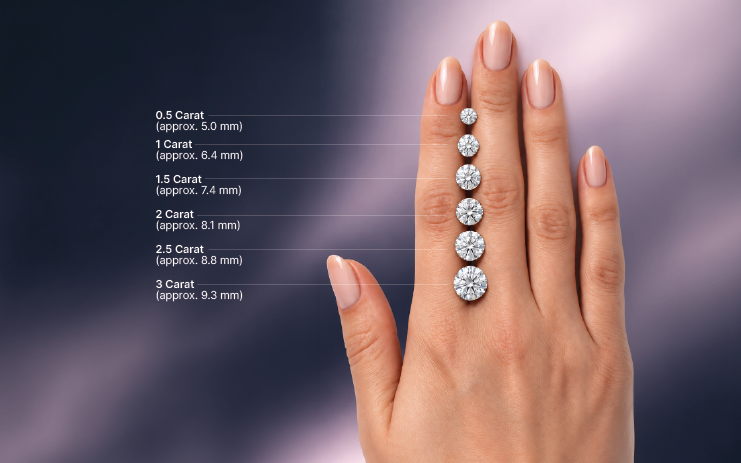
Diamond Size Chart: Carat to MM Matrix
Carat is a measure of diamond weight, not physical size. Explore the exact millimeter (mm) dimensions, surface area, and finger coverage for all 10 certified diamond silhouettes.
| Carat Weight | Dimensions (L × W) | Surface Area | Finger Coverage | Recommended Setting |
|---|---|---|---|---|
| 0.50 ct | 5.1 × 5.1 mm | 20.4 mm² |
31%
|
Classic 4 or 6-Prong Solitaire |
| 0.75 ct | 5.8 × 5.8 mm | 26.4 mm² |
35%
|
Pavé Band Solitaire |
| 1.00 ct | 6.5 × 6.5 mm | 33.2 mm² |
39%
|
Cathedral Solitaire / Bezel |
| 1.25 ct | 6.9 × 6.9 mm | 37.4 mm² |
42%
|
Three-Stone Diamond Band |
| 1.50 ct | 7.4 × 7.4 mm | 43.0 mm² |
45%
|
Hidden Halo Atelier Mount |
| 1.75 ct | 7.7 × 7.7 mm | 46.6 mm² |
47%
|
Tapered Baguette Mount |
| 2.00 ct | 8.1 × 8.1 mm | 51.5 mm² |
49%
|
High-Profile Platinum 6-Prong |
| 2.50 ct | 8.8 × 8.8 mm | 60.8 mm² |
53%
|
Signature Maison Mount |
| 3.00 ct | 9.3 × 9.3 mm | 67.9 mm² |
56%
|
Split-Shank Atelier Solitaire |
| 4.00 ct | 10.2 × 10.2 mm | 81.7 mm² |
62%
|
Custom Master Atelier Setting |
| 5.00 ct | 11.0 × 11.0 mm | 95.0 mm² |
67%
|
High-Jewellery Platinum Masterpiece |
| Carat Weight | Dimensions (L × W) | Surface Area | Finger Coverage | Recommended Setting |
|---|---|---|---|---|
| 0.50 ct | 6.0 × 4.0 mm | 18.8 mm² |
36%
|
Delicate 4-Prong Solitaire |
| 0.75 ct | 6.8 × 4.8 mm | 25.6 mm² |
41%
|
Pavé Petite Whisper Band |
| 1.00 ct | 7.7 × 5.7 mm | 34.5 mm² |
47%
|
Hidden Halo Solitaire |
| 1.25 ct | 8.3 × 6.0 mm | 39.1 mm² |
50%
|
East-West Bezel or Solitaire |
| 1.50 ct | 8.8 × 6.3 mm | 43.5 mm² |
53%
|
Six-Prong Platinum Crown |
| 1.75 ct | 9.2 × 6.6 mm | 47.7 mm² |
56%
|
Three-Stone Pear Side Mounts |
| 2.00 ct | 9.9 × 7.0 mm | 54.4 mm² |
60%
|
Cathedral Knife-Edge Shank |
| 2.50 ct | 10.6 × 7.5 mm | 62.4 mm² |
64%
|
Signature Atelier Setting |
| 3.00 ct | 11.3 × 8.0 mm | 71.0 mm² |
68%
|
Bespoke Half-Moon Side Mount |
| 4.00 ct | 12.4 × 8.8 mm | 85.7 mm² |
75%
|
Haute Joaillerie Statement Band |
| 5.00 ct | 13.3 × 9.5 mm | 99.2 mm² |
81%
|
Museum Collection Atelier Mount |
| Carat Weight | Dimensions (L × W) | Surface Area | Finger Coverage | Recommended Setting |
|---|---|---|---|---|
| 0.50 ct | 5.5 × 3.8 mm | 20.9 mm² |
33%
|
Minimalist Solitaire |
| 0.75 ct | 6.2 × 4.3 mm | 26.7 mm² |
38%
|
Classic Bezel Setting |
| 1.00 ct | 7.0 × 5.0 mm | 35.0 mm² |
42%
|
Tapered Baguette Three-Stone |
| 1.25 ct | 7.5 × 5.3 mm | 39.8 mm² |
45%
|
Double Claw Corner Prongs |
| 1.50 ct | 8.0 × 5.5 mm | 44.0 mm² |
48%
|
Art Deco Geometric Crown |
| 1.75 ct | 8.4 × 5.8 mm | 48.7 mm² |
51%
|
East-West Platinum Bezel |
| 2.00 ct | 8.8 × 6.2 mm | 54.6 mm² |
53%
|
Double-Prong Cathedral Band |
| 2.50 ct | 9.5 × 6.7 mm | 63.7 mm² |
58%
|
Trapezoid Side Stone Mount |
| 3.00 ct | 10.1 × 7.1 mm | 71.7 mm² |
61%
|
High Maison Atelier Architecture |
| 4.00 ct | 11.0 × 7.8 mm | 85.8 mm² |
67%
|
Bespoke Solid Platinum Vitrine |
| 5.00 ct | 11.8 × 8.4 mm | 99.1 mm² |
72%
|
Heritage Master Collector Mount |
| Carat Weight | Dimensions (L × W) | Surface Area | Finger Coverage | Recommended Setting |
|---|---|---|---|---|
| 0.50 ct | 4.4 × 4.4 mm | 19.4 mm² |
27%
|
V-Prong Solitaire |
| 0.75 ct | 5.0 × 5.0 mm | 25.0 mm² |
30%
|
Channel-Set Diamond Band |
| 1.00 ct | 5.5 × 5.5 mm | 30.3 mm² |
33%
|
Square Halo Atelier Mount |
| 1.25 ct | 6.0 × 6.0 mm | 36.0 mm² |
36%
|
Pavé Bridge Cathedral |
| 1.50 ct | 6.4 × 6.4 mm | 41.0 mm² |
39%
|
Trillion Side Stone Trilogy |
| 1.75 ct | 6.7 × 6.7 mm | 44.9 mm² |
41%
|
Beveled Platinum Knife-Edge |
| 2.00 ct | 7.0 × 7.0 mm | 49.0 mm² |
42%
|
Modern Flush Bezel |
| 2.50 ct | 7.6 × 7.6 mm | 57.8 mm² |
46%
|
Heavy Platinum V-Prong |
| 3.00 ct | 8.1 × 8.1 mm | 65.6 mm² |
49%
|
Architectural Modernist Setting |
| 4.00 ct | 8.9 × 8.9 mm | 79.2 mm² |
54%
|
Master Jeweller Custom Cast |
| 5.00 ct | 9.6 × 9.6 mm | 92.2 mm² |
58%
|
Grand Statement Atelier Mount |
| Carat Weight | Dimensions (L × W) | Surface Area | Finger Coverage | Recommended Setting |
|---|---|---|---|---|
| 0.50 ct | 4.8 × 4.5 mm | 21.6 mm² |
29%
|
Four-Prong Wire Basket |
| 0.75 ct | 5.4 × 5.1 mm | 27.5 mm² |
33%
|
Vintage Milgrain Pavé |
| 1.00 ct | 6.0 × 5.6 mm | 33.6 mm² |
36%
|
Soft Cushion Halo |
| 1.25 ct | 6.5 × 6.0 mm | 39.0 mm² |
39%
|
Double Claw Prong Solitaire |
| 1.50 ct | 6.9 × 6.4 mm | 44.2 mm² |
42%
|
Cadillac Side Stone Mount |
| 1.75 ct | 7.2 × 6.7 mm | 48.2 mm² |
44%
|
Hidden Halo Pavé Gallery |
| 2.00 ct | 7.5 × 7.0 mm | 52.5 mm² |
45%
|
Classic Cathedral Trilogy |
| 2.50 ct | 8.1 × 7.5 mm | 60.8 mm² |
49%
|
Antique Reproduction Solitaire |
| 3.00 ct | 8.6 × 8.0 mm | 68.8 mm² |
52%
|
High Atelier Platinum Basket |
| 4.00 ct | 9.4 × 8.8 mm | 82.7 mm² |
57%
|
Custom Hand-Forged Mount |
| 5.00 ct | 10.1 × 9.5 mm | 96.0 mm² |
61%
|
Museum Solitaire Crown |
| Carat Weight | Dimensions (L × W) | Surface Area | Finger Coverage | Recommended Setting |
|---|---|---|---|---|
| 0.50 ct | 5.0 × 4.0 mm | 20.0 mm² |
30%
|
Corner-Claw Solitaire |
| 0.75 ct | 5.7 × 4.6 mm | 26.2 mm² |
35%
|
Petite Pavé Band |
| 1.00 ct | 6.4 × 5.1 mm | 32.6 mm² |
39%
|
Hidden Halo Atelier Crown |
| 1.25 ct | 6.9 × 5.5 mm | 38.0 mm² |
42%
|
Trillion Diamond Three-Stone |
| 1.50 ct | 7.3 × 5.9 mm | 43.1 mm² |
44%
|
Four Double-Claw Cathedral |
| 1.75 ct | 7.7 × 6.2 mm | 47.7 mm² |
47%
|
Trapezoid Side Stone Mount |
| 2.00 ct | 8.0 × 6.5 mm | 52.0 mm² |
48%
|
High Platinum Solitaire |
| 2.50 ct | 8.7 × 7.0 mm | 60.9 mm² |
53%
|
Signature Maison Radiant Mount |
| 3.00 ct | 9.2 × 7.5 mm | 69.0 mm² |
56%
|
Bespoke Tapered Baguette Trilogy |
| 4.00 ct | 10.1 × 8.2 mm | 82.8 mm² |
61%
|
Haute Joaillerie Statement |
| 5.00 ct | 10.9 × 8.8 mm | 95.9 mm² |
66%
|
Atelier Collector Masterpiece |
| Carat Weight | Dimensions (L × W) | Surface Area | Finger Coverage | Recommended Setting |
|---|---|---|---|---|
| 0.50 ct | 6.5 × 4.2 mm | 21.4 mm² |
39%
|
V-Tip Protected Solitaire |
| 0.75 ct | 7.5 × 4.8 mm | 28.3 mm² |
45%
|
Whisper Pavé Teardrop |
| 1.00 ct | 8.5 × 5.5 mm | 36.7 mm² |
52%
|
Hidden Halo Pear Crown |
| 1.25 ct | 9.1 × 5.9 mm | 42.2 mm² |
55%
|
East-West Modern Setting |
| 1.50 ct | 9.7 × 6.3 mm | 47.9 mm² |
59%
|
Five-Prong with V-Cap Solitaire |
| 1.75 ct | 10.2 × 6.6 mm | 52.9 mm² |
62%
|
Tapered Diamond Shank |
| 2.00 ct | 10.7 × 7.0 mm | 58.8 mm² |
65%
|
Round Brilliant Shoulder Stones |
| 2.50 ct | 11.5 × 7.5 mm | 67.7 mm² |
70%
|
Signature Atelier Teardrop Mount |
| 3.00 ct | 12.2 × 8.0 mm | 76.6 mm² |
74%
|
High Jewellery Split-Shank |
| 4.00 ct | 13.4 × 8.8 mm | 92.6 mm² |
81%
|
Custom Handcrafted Platinum Crown |
| 5.00 ct | 14.4 × 9.5 mm | 107.4 mm² |
87%
|
Grand Atelier Exhibition Ring |
| Carat Weight | Dimensions (L × W) | Surface Area | Finger Coverage | Recommended Setting |
|---|---|---|---|---|
| 0.50 ct | 7.5 × 4.0 mm | 23.6 mm² |
45%
|
V-Tip Dual End Prongs |
| 0.75 ct | 8.7 × 4.5 mm | 30.7 mm² |
53%
|
Six-Prong Atelier Band |
| 1.00 ct | 10.0 × 5.0 mm | 39.3 mm² |
61%
|
East-West Modern Bezel |
| 1.25 ct | 10.8 × 5.4 mm | 45.8 mm² |
65%
|
Hidden Halo Navette Mount |
| 1.50 ct | 11.5 × 5.8 mm | 52.4 mm² |
70%
|
Cathedral Solitaire with V-Tips |
| 1.75 ct | 12.1 × 6.1 mm | 57.9 mm² |
73%
|
Tapered Baguette Side Stones |
| 2.00 ct | 12.7 × 6.4 mm | 63.8 mm² |
77%
|
High-Profile Platinum 6-Prong |
| 2.50 ct | 13.7 × 6.9 mm | 74.2 mm² |
83%
|
Signature Navette Atelier Setting |
| 3.00 ct | 14.5 × 7.3 mm | 83.1 mm² |
88%
|
High Maison Statement Mount |
| 4.00 ct | 16.0 × 8.0 mm | 100.5 mm² |
97%
|
Handcrafted Royal Crown |
| 5.00 ct | 17.2 × 8.6 mm | 116.2 mm² |
104%
|
Bespoke Masterpiece Mount |
| Carat Weight | Dimensions (L × W) | Surface Area | Finger Coverage | Recommended Setting |
|---|---|---|---|---|
| 0.50 ct | 4.4 × 4.4 mm | 19.4 mm² |
27%
|
Corner-Claw Vintage Mount |
| 0.75 ct | 5.0 × 5.0 mm | 25.0 mm² |
30%
|
Art Deco Milgrain Pavé |
| 1.00 ct | 5.5 × 5.5 mm | 30.3 mm² |
33%
|
Classic 4-Prong Cathedral |
| 1.25 ct | 6.0 × 6.0 mm | 36.0 mm² |
36%
|
Octagonal Flush Bezel |
| 1.50 ct | 6.4 × 6.4 mm | 41.0 mm² |
39%
|
Double Claw Corner Solitaire |
| 1.75 ct | 6.7 × 6.7 mm | 44.9 mm² |
41%
|
Baguette Diamond Trilogy |
| 2.00 ct | 7.0 × 7.0 mm | 49.0 mm² |
42%
|
Platinum Antique Reproduction |
| 2.50 ct | 7.6 × 7.6 mm | 57.8 mm² |
46%
|
Signature Asscher Atelier Mount |
| 3.00 ct | 8.1 × 8.1 mm | 65.6 mm² |
49%
|
High Maison Art Deco Setting |
| 4.00 ct | 8.9 × 8.9 mm | 79.2 mm² |
54%
|
Custom Hand-Forged Platinum |
| 5.00 ct | 9.6 × 9.6 mm | 92.2 mm² |
58%
|
Heritage Master Collector Crown |
| Carat Weight | Dimensions (L × W) | Surface Area | Finger Coverage | Recommended Setting |
|---|---|---|---|---|
| 0.50 ct | 5.0 × 5.0 mm | 19.6 mm² |
30%
|
Three-Prong V-Tip Solitaire |
| 0.75 ct | 5.8 × 5.8 mm | 26.4 mm² |
35%
|
Petite Pavé Band Mount |
| 1.00 ct | 6.5 × 6.5 mm | 33.2 mm² |
39%
|
Heart Outline Hidden Halo |
| 1.25 ct | 7.0 × 7.0 mm | 38.5 mm² |
42%
|
Modern Bezel Solitaire |
| 1.50 ct | 7.4 × 7.4 mm | 43.0 mm² |
45%
|
Five-Prong Atelier Crown |
| 1.75 ct | 7.8 × 7.8 mm | 47.8 mm² |
47%
|
Tapered Platinum Shank |
| 2.00 ct | 8.2 × 8.2 mm | 52.8 mm² |
50%
|
Cathedral Solitaire Setting |
| 2.50 ct | 8.8 × 8.8 mm | 60.8 mm² |
53%
|
Signature Heart Atelier Setting |
| 3.00 ct | 9.4 × 9.4 mm | 69.4 mm² |
57%
|
High Maison Romantic Trilogy |
| 4.00 ct | 10.3 × 10.3 mm | 83.3 mm² |
62%
|
Custom Handcrafted Platinum |
| 5.00 ct | 11.1 × 11.1 mm | 96.8 mm² |
67%
|
Museum Collection Masterpiece |
Carat Weight vs Physical Millimeters
Carat is strictly a measurement of weight (1.00 ct = 0.20 grams). Two diamonds of identical carat weight can have markedly different surface diameters depending on how deeply the stone was cut by the master cutter.
The Optical Elongation Advantage
Fancy elongated shapes like Oval, Marquise, Emerald, and Pear distribute their mass across a longer surface axis, creating a visual footprint that appears 12% to 18% larger on the hand than an equivalent round brilliant.
Cut Quality Maximizes Spread
An Ideal or Excellent cut grade ensures weight is not hidden in an overly deep pavilion or thick girdle. This delivers maximum face-up millimeter spread and intense brilliance across all lighting conditions.